

Week 5 was a mix of making the ZH selection more realistic, trying out the first non-zero Wilson coefficients, and going down a dark matter rabbit hole in lectures.
Monday 27th October — Dark matter and “scintillates like a pig”
This Monday’s DM lecture was a nice change of pace from fighting with Herwig cards.
We went through the usual story: dark matter shows up in galaxy rotation curves, lensing, CMB and so on, but has never been directly detected. The three fronts are:
- direct detection in underground detectors,
- indirect detection via decay or annihilation products,
- and collider production (where my project sits).
The fun part was going through detector technologies:
- Liquid xenon and argon experiments (LZ, DarkSide, DEAP), with the classic two-phase design: S1 prompt light, then drifting electrons up to create S2, so you get both timing and position information. Liquid xenon “scintillates like a pig”, apparently.
- Solid detectors with crystals like germanium or tellurium, reading out phonons and light with transition edge sensors and SQUIDs.
- Gaseous detectors with beautiful track information but tiny target mass.
We also talked about backgrounds: uranium and thorium chains, radon (the worst), neutrons from (alpha, n) reactions, and cosmic-ray activation of cavern rock. The overall message: even before you see any DM, the detector is already busy with the Standard Model.
It is nice to see how all this links back to collider searches: they are all poking at the same question from different angles.
Z pT cuts in Herwig – focusing on the boosted regime
Back to the project.
To move closer to the phase space where my boosted Higgs tagger is relevant, I started applying generator-level cuts on the Z transverse momentum in Herwig:
- set /Herwig/Cuts/JetKtCut:MinKT 150*GeV
- set /Herwig/Cuts/JetZ0Cut:MinKT 150*GeV
Effect:
- The inclusive ZH cross section dropped sharply after these cuts, which is exactly what should happen if I insist on high-pT Z bosons.
- MadGraph and Herwig agreed on the new, smaller cross sections to within statistical errors.
I also looked at a more aggressive Z pT cut around 400 GeV. Again, the pattern was consistent: both generators see a big suppression, landing around the 10^-2 pb level at 85 TeV. This is the region where the Higgs is so boosted that it really looks like a single fat jet, which is what my Rivet routine is designed to tag.
First BSM benchmark: switching on cH, cHW, cHB
With the SM baseline in good shape, I tried the first “toy” BSM point in HEL:
- cH = 0.2
- cHW = 0.1
- cHB = 0.1
at 85 TeV.
This is not meant to be realistic; the aim is just to test that the UFO model and Herwig can cope with non-zero coefficients.
Results:
- The SM / coefficient-zero cross section at 85 TeV is around 5–6 pb.
- For the BSM point above, MadGraph gave roughly 197 pb and Herwig about 205 pb.
So turning on these operators boosts the ZH rate by a large factor, and both generators see the same effect. That gives me confidence that the HEL implementation works not just in the SM limit but also in a non-trivial BSM point. It is now safe to start thinking about scanning over a grid of coefficients.
Rivet routine and cut-flow – now with proper numbers
On the analysis side, this week was about running larger event samples through the Rivet routine and checking that the cut-flow makes sense.
The event is kept only if:
- the missing energy is above a set threshold,
- the leading big jet passes basic pT and eta cuts,
- the jet contains b-hadrons (so it looks like it came from H -> bb),
- the jet mass is close to the Higgs mass window, around 115–140 GeV,
- and the ratio of jet pT to MET sits within a loose range (roughly 0.8–1.2).
From the Herwig logs I can now read off:
- how many events pass the MET cut,
- how many survive the fat-jet and b-tagging requirements,
- how many end up as tagged Higgs candidates after the mass window.
It is still early days, but at least the numbers are stable and the efficiencies are in a sensible ballpark.
Small quality-of-life improvements
To stop myself from re-typing the same commands all week, I also:
- set up some bash aliases for quicker logins to the cluster,
- wrote a simple Herwig qsub script for batch jobs,
- and cleaned up the directory structure a bit so different runs (SM vs BSM, different cuts) are easier to track.
Not very exciting, but future-me will probably be grateful.
Friday 31st Oct UCL ATLAS meeting and Spooky Halloween 👻:
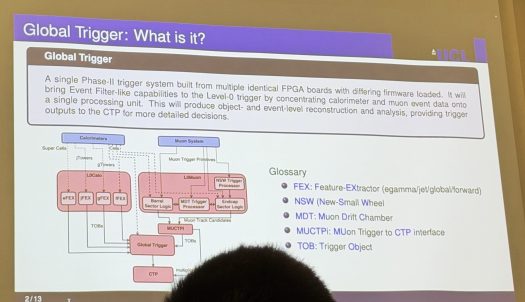
ATLAS weekly overview and Alex gave a talk on Global Trigger.
I finished the week in a more human part of particle physics: the Friday UCL ATLAS meeting.
We had the usual round of ATLAS news, this time presented via a collaboration-wide slide set. It is a good reminder that behind all the plots and cross sections there is a very large organisation that someone actually has to run.
The slide was essentially collaboration politics in bullet-point form: endorsement of new committee chairs and co-ordinators, a list of open roles, and a long list of institutes joining ATLAS. One highlight for UCL was seeing Jon Butterworth’s name on the screen as Outreach and Education Co-Coordinator for ATLAS from 2026 to 2028. It is slightly surreal to sit in a small meeting room in Gower Street and watch your project supervisor’s name come up on a collaboration slide that represents thousands of physicists.
There was also a parade of open positions: computing co-coordinator, data preparation, trigger, physics co-coordinators, publications, early-career boards, diversity and inclusion roles, and so on. It is a good snapshot of how much invisible work goes into keeping a big experiment alive: software, calibration, documentation, outreach, internal review. All of that has to function before anyone can claim a fancy physics result.
For me, as a student just starting to work on a relatively narrow FCC study, it is a useful reality check. The analysis I am developing now sits at the end of a chain that, in ATLAS, is supported by an entire ecosystem of people in roles like the ones on that slide. If I do end up in this world long-term, at some point I will need to contribute on that side as well, not just in analysis code.
Week 5 in one line
The project finally feels like a pipeline: SM and BSM ZH samples with realistic pT cuts, a working Rivet routine with a clear cut-flow, and a better understanding of where dark matter fits into the bigger picture.
PS: By FAR the cooliest Halloween custom EVER !!!

 Noot in Circle