Cambridge / ATLAS · Explainer
What is ATLAS, and what does it do?
On the homepage, two dots go around a ring and meet at ATLAS. In the real Large Hadron Collider (LHC), beams of protons travel in opposite directions in separate pipes. At a few points around the ring, the beams cross and some of the protons collide. ATLAS is a general-purpose particle detector built around one of those crossings, Point 1. It is also the name of the collaboration that operates the detector and studies the data. CERN’s ATLAS overview and guide to the collision points.
Start with one collision. Particles fly out from the centre and cross layers that measure different things. ATLAS pieces those measurements together to reconstruct what happened.
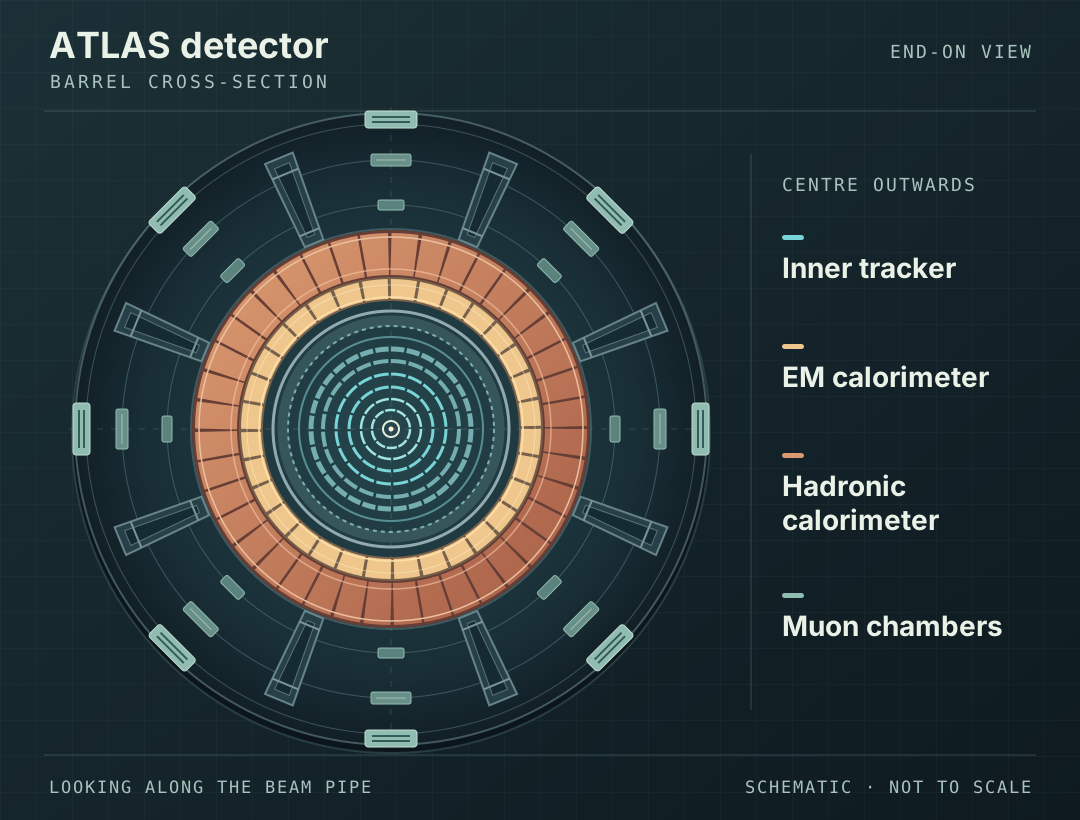
What each layer measures
- Inner tracking detector. Charged particles leave a series of hits as they pass through sensors near the beam pipe. A magnetic field bends their paths. From the direction and amount of bending, we can infer the sign of a particle’s charge and help determine its momentum. ATLAS inner detector.
- Calorimeters. When particles interact with dense material, they can produce a shower of secondary particles. The calorimeters sample the energy deposited by the shower to estimate the original particle’s energy. The electromagnetic layers are designed for electrons and photons. The hadronic layers measure showers from particles such as pions and protons. ATLAS calorimeters.
- Muon spectrometer. Muons often pass through the calorimeters and reach the outer chambers. By measuring how their paths bend in the field of the large toroidal magnets, the spectrometer can estimate their momentum independently of the inner tracker. ATLAS muon spectrometer.
How a collision becomes a physics measurement
Collisions arrive too quickly to save all the detector data. A system called the trigger makes a fast first decision using hardware. Software then examines the selected events in more detail and decides which ones to record. Reconstruction software combines the detector signals into things we can analyse, such as tracks, photons and jets. ATLAS trigger and data acquisition.
The Higgs boson is a good example of what you can do with that record. In one type of analysis, we use the energies and directions of two photons to calculate the mass of the particle that could have produced them. When many such events are plotted together, Higgs decays contribute a peak near 125 GeV above the background. The same detector can measure known processes in more detail and search for patterns we have yet to see. ATLAS Higgs measurements.
Where my Cambridge project comes in
A hypothetical long-lived particle could reach the muon spectrometer before it decays. The resulting tracks can point back to a spot away from the beam crossing, called a displaced vertex. In my MPhil, I’m investigating whether machine learning can help use those short segments to locate the decay. Read what a segment measures or see ATLAS’s displaced-vertex search.
See how reconstruction works
Try the displaced-decay walkthrough